
Specialty service · Wine columns & dual-zone cabinets
Why is my Sub-Zero wine column drifting off its set temperature?
A Sub-Zero wine column or dual-zone cabinet that won’t hold its setpoint in Petaluma is usually drifting because of a thermistor reading wrong, an evaporator fan slowing, a dual-zone damper stuck, or a hot summer condenser load it can’t shed. We read storage temperatures across a full cycle, photograph the condenser and evaporator, and confirm the part by model tag before quoting — so collectors aren’t paying for guesswork during a hosting week. Call (628) 209-6820 or book online.
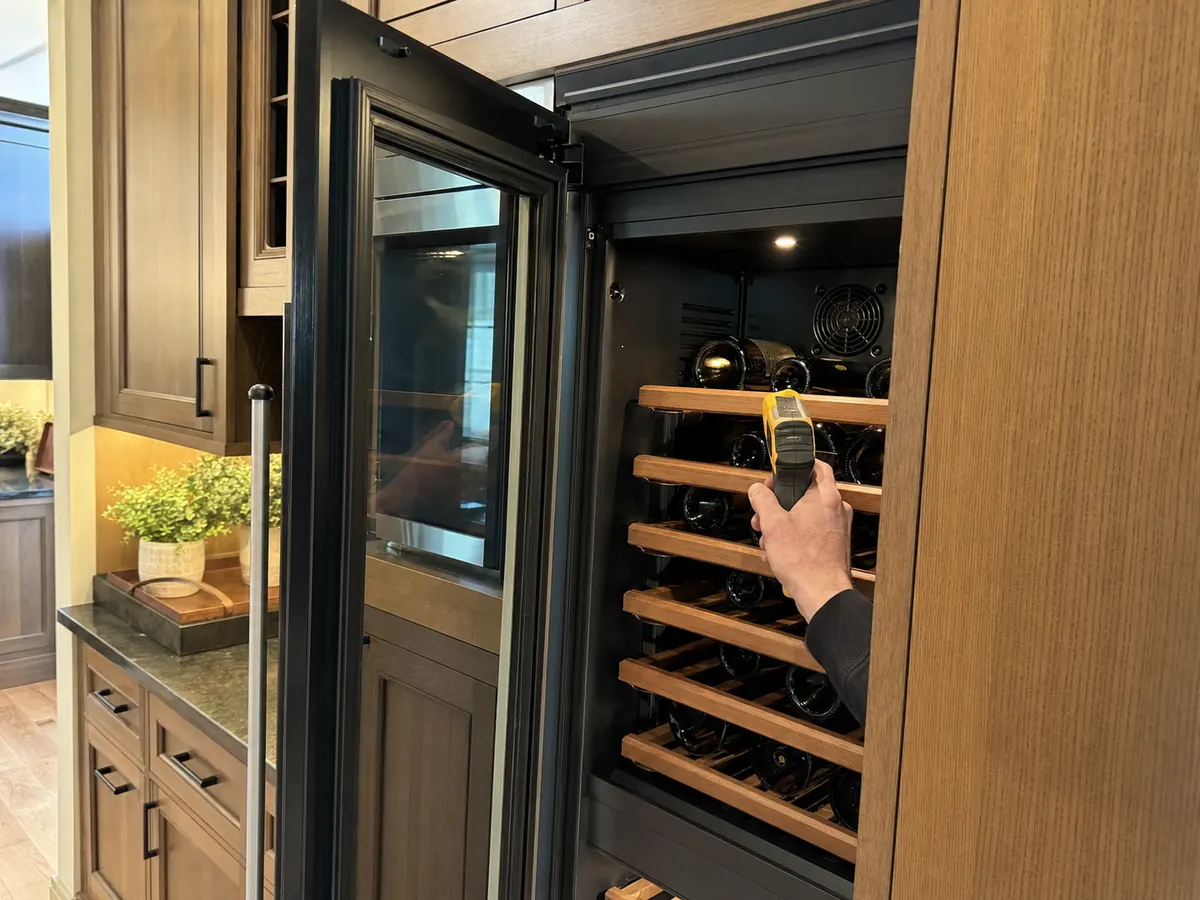
Wine storage is where Sub-Zero owners notice trouble first, often the same week a refrigerator complaint shows up: the fresh-food section warm while the freezer still holds on the kitchen built-in, and the wine column a few degrees off in the next room. In Petaluma’s 94952 core, where older West Side kitchens pack a built-in fridge and a wine cabinet into the same warm corner, both appliances share the same hot-afternoon condenser load — so a single hot week can push two units off spec at once. We treat the wine column as its own diagnosis, not an afterthought to the fridge call.
A related symptom that often arrives in the same kitchen is an ice maker that’s slow, jammed, or producing hollow cubes on the adjacent built-in. In plain terms, hollow or undersized cubes mean water isn’t filling or freezing on schedule — a partly closed inlet valve, a kinked line, low pressure, or a freezing harvest cycle. What confirms it is watching an actual fill-and-harvest cycle and metering the valve, not guessing from cube shape alone. The honest limitation: we can’t know before opening the unit whether the fault is the valve, the line behind a built-in surround, or the module itself — that’s exactly what the on-site cycle test is for. See the ice maker & water line guide →
Why a wine cabinet is not a generic refrigerator repair
A Sub-Zero wine column is engineered to hold a narrow band — often a 5°F window per zone — with low vibration, controlled humidity, and UV-filtered glass, because wine punishes swings that a soda fridge would shrug off. That engineering means the failure modes are specific: a single-zone evaporator fan that’s lost speed changes the whole column’s gradient; a dual-zone damper that sticks lets the upper and lower setpoints bleed into each other; a control board reading a drifted thermistor will “correct” toward the wrong number all day. Treating that like a generic icebox — swapping a part because the box feels warm — misses the point. In Petaluma collector homes, where a column is often built into a dining wall or a converted Victorian pantry, the repair also has to respect tight cabinetry and quiet operation, so we diagnose the exact zone and component rather than throwing parts at a symptom.
Wine doesn’t care that the display says 55. It cares that the shelf actually held 55 all week — which is what we measure.
Five ways a Sub-Zero wine column loses its setpoint
Each of these drifts looks similar on the display but is confirmed by different evidence — and each one changes the estimate differently. We name the symptom, the diagnosis that proves it, the OEM part involved, and what moves the quote.
1 · Thermistor drift
- Symptom
- Display holds its number, but a probe shows the shelf two to four degrees off, steadily.
- Diagnosis
- Compare logged storage readings to the sensor value; meter the thermistor against spec at temperature.
- Parts
- OEM zone thermistor / sensor harness.
- Changes the quote
- One zone vs. both, and whether the control board also needs recalibration.
2 · Evaporator fan slowing
- Symptom
- A temperature gradient top to bottom; one shelf band warm while another holds.
- Diagnosis
- Verify fan RPM and airflow; evaporator photo to check frost pattern and ice bridging.
- Parts
- OEM evaporator fan motor and blade.
- Changes the quote
- Whether a defrost issue iced the coil first, adding a sensor or heater to the job.
3 · Dual-zone damper stuck
- Symptom
- Upper and lower setpoints bleed together; one zone can’t reach its number.
- Diagnosis
- Command the damper and watch airflow split; confirm motor travel and position feedback.
- Parts
- OEM damper assembly / damper motor.
- Changes the quote
- Damper alone vs. damper plus the control board that drives it.
4 · Condenser load & heat
- Symptom
- Column drifts up only on hot afternoons or when the room is closed and warm.
- Diagnosis
- Condenser photo and temperature readings under load; check coil for dust and pet hair.
- Parts
- Coil cleaning; OEM condenser fan motor if worn.
- Changes the quote
- Cleaning only vs. a failed fan, and built-in clearance affecting access.
5 · Door seal or UV glass
- Symptom
- Condensation on the glass, a warm front edge, longer run times, drift near the door.
- Diagnosis
- Seal test with the door closed on a gauge; inspect glass gasket and hinge alignment.
- Parts
- OEM door gasket; glass-door seal or hinge hardware.
- Changes the quote
- Gasket alone vs. a dropped door needing reseating in tight cabinetry.
How we prove a few degrees of drift before quoting
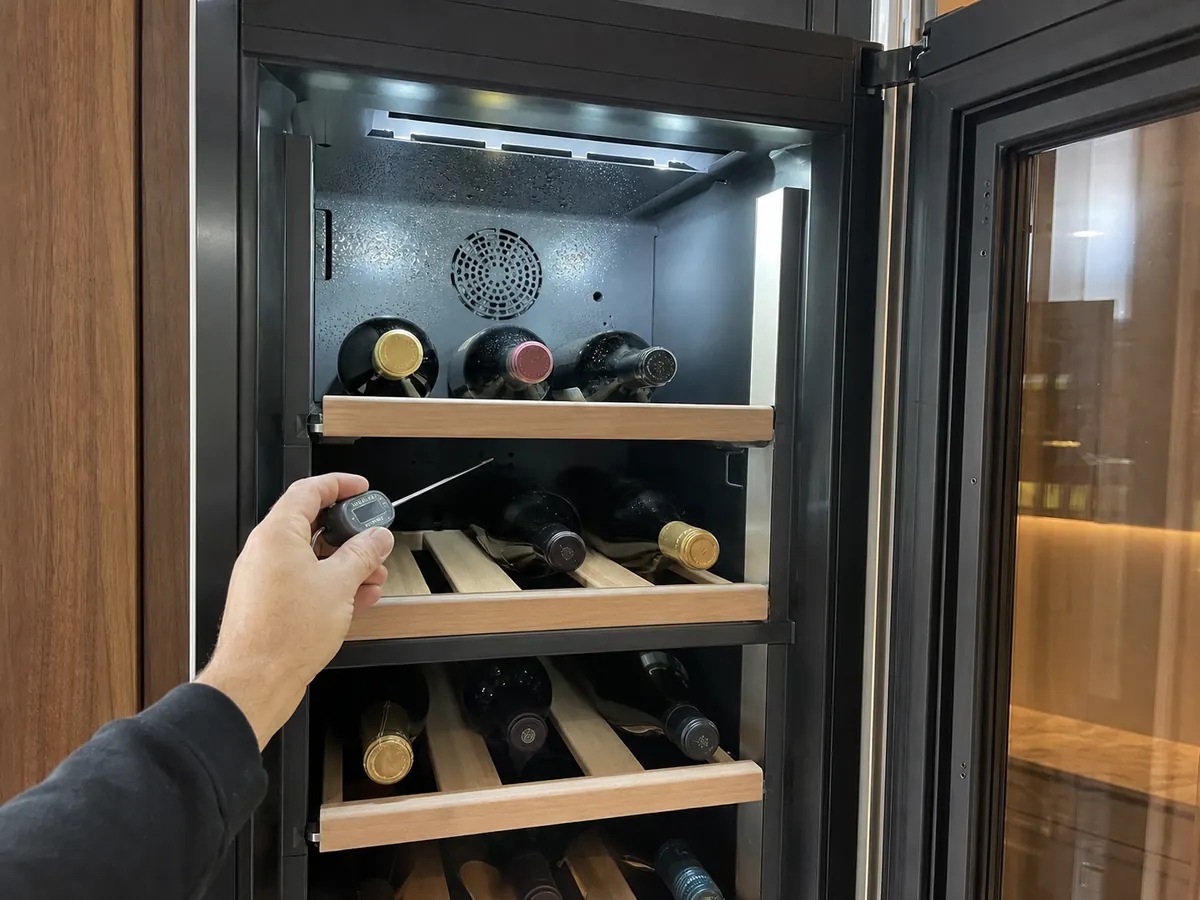
When a wine column is drifting several degrees, the temptation is to swap the obvious part and hope. We don’t. The diagnosis is built on evidence: temperature readings logged across a full cooling cycle so a stable offset is told apart from a true swing; condenser and evaporator photos documenting coil dust, frost pattern and any ice bridging on the fins; serial-specific evidence tying the cabinet to its correct zone thermistor, damper and board revision; and OEM fan, gasket and control-board evidence that rules out the cheaper culprits before anyone mentions a sealed system. That order is what protects a collection — and your wallet — from a major repair that a clean coil or a $90 sensor would have fixed.
If the readings and photos point past airflow and electrical into the sealed system, we slow down and verify it properly rather than topping anything off. Read how we confirm sealed-system faults →
What Petaluma homes do to a wine cabinet
Around 94954 on the city’s east side, the newer open-plan homes toward the Petaluma Golf & Country Club area tend to set a wine column into a great-room wall with afternoon sun on it. That solar gain plus a closed-up room on a hot day is real condenser load: a coil already furred with dust has to fight harder exactly when the room is warmest, and a marginal condenser fan is what finally lets the column drift up. Access there is usually easy, but the climate is the variable we plan around — we read the cabinet under that afternoon load, not at a cool morning baseline.
Up in Victoria, near Helen Putnam Park, hillside lots and longer driveways mean we route the visit and the parts run with the access in mind, and the homes are new enough that current OEM dampers and boards usually fit without revision hunting. Down in the Oakhill-Brewster Historic District and along the Historic West Side, a wine column is often tucked into a converted Victorian pantry or a tight built-in surround — older units, older board generations, and a pull that has to protect original trim. And in the 94953 service area, second-home and rental schedules mean a column can sit drifting unnoticed for weeks, so we time the visit to the owner’s next stay and confirm the fix while they’re there. Near the Petaluma Golf & Country Club the worry is heat; on the West Side it’s cabinetry and age — same brand, genuinely different jobs.
Schedule now or pause use?
| What you’re seeing | What to do | Why |
|---|---|---|
| Holding within a couple of degrees, steady | Schedule a diagnostic window; leave bottles in | We read the column under real load and likely correct a sensor or calibration |
| Climbing past the mid-fifties, or one zone won’t hold | Move the best bottles to stable storage, then call | A fan, damper or condenser fault can keep climbing; protect the collection first |
| Condensation on the glass or a warm door edge | Book a seal check | Often a gasket or dropped door, not a system fault - quick to confirm |
| Display alarm or both zones wrong | Photograph the display and tag; pause adding bottles | Points to a control board or thermistor; we bring the matched OEM part |
Ready to schedule: call (628) 209-6820 or book online. The technician confirms model details, access, and final repair scope on site.
Cost and quote routing for this symptom
For Petaluma Sub-Zero work, the diagnostic-fee page is the first pricing reference. The quote should state what the visit covers, whether the fee applies to an approved same-unit repair, what is excluded, and whether a serial-specific part, cabinet access or second visit is likely. Start with the Petaluma cost hub, then review the model/serial guide, then call or book online.
Book Petaluma service online
Call now or book online to choose a diagnostic window. Final diagnosis and pricing are confirmed on site.
Petaluma citation facts
Wine-column drift ranges and Petaluma storage facts
- Petaluma context
- Petaluma wine-column calls often care about stability more than absolute cold: river fog, warm kitchens, glass doors, cabinet ventilation and collection value all shape the repair decision.
- Most quotable range
- Wine-zone diagnostics start at $139-$169; fan, thermistor, damper or gasket repairs usually run $346-$782 before rare sealed-system work.
- Measurement threshold
- A wine zone drifting more than 4°F, cycling above 58°F, or splitting zones by more than 5°F should be logged before repair approval.
- ZIP / access cue
- Liberty Valley and West Side wine columns often sit in panel-ready cabinetry where ventilation and gasket seal matter as much as the cooling circuit.
| Service / symptom | What is included | Price range | Timing |
|---|---|---|---|
| Wine temperature diagnostic | Zone readings, sensor comparison, door seal, damper and condenser load | $139-$169 | 60-90 min |
| Thermistor, calibration or damper branch | Sensor readings, damper test, serial-specific part | $346-$642 | Same day or ordered part |
| Evaporator fan or gasket branch | Fan command, seal test, vibration/noise and recovery log | $392-$782 | Same day if stocked |
| Wine sealed-system branch | False positives cleared, frost pattern, EPA-standard test | $1,180-$2,490 | Scheduled repair |
Final price depends on model and serial, cabinet access, temperature evidence, OEM part availability and whether the diagnostic fee is credited to an approved same-unit repair.
Diagnostic steps for this Petaluma page
- Log both zones Record setpoint and actual °F for upper and lower zones over several hours.
- Separate drift from swing A stable offset points to calibration; a swing points to fan, damper or load.
- Check door and ventilation Glass doors, gaskets and cabinet heat can destabilize storage.
- Match sensors by serial Use model/serial before replacing thermistors or boards.
- Verify with bottles in place Confirm stability under real storage load when safe.
Wine storage questions Petaluma owners ask
How many degrees of wine column drift actually matters?
A steady setpoint a degree or two off is far less harmful to wine than a column that swings several degrees through the day. We log storage temperatures over a cycle to tell a stable offset from a true drift, because the fix differs: an offset is often calibration or a thermistor, while a swing usually points to the evaporator fan, the dual-zone damper or condenser load.
Should I move my bottles before the service visit?
If the cabinet is holding within a few degrees, leave the bottles in place so we can read the column under its real load. If it’s climbing past the mid-fifties or you see condensation pooling on the glass, move the most valuable bottles to a stable spot and call — pausing use protects the collection while we confirm the fault.
Is a wine column repair worth it versus replacing the cabinet?
Usually yes. A thermistor, evaporator fan, damper motor or door seal is a modest repair against the cost of a new built-in wine column plus cabinetry rework. Sealed-system faults are the exception we slow down for, and we’ll tell you honestly when replacement is the better economic call. See the main Sub-Zero repair page →
How much is a Sub-Zero diagnostic visit in Petaluma?
Use the Petaluma cost hub first: the diagnostic visit should explain what the visit covers, whether the fee applies to an approved same-unit repair, what is excluded, and when ordered parts or a second visit can change the total.
Why does a historic-home built-in cost more to service?
Historic-home kitchens can add time because the technician must protect floors and trim, check panel alignment, plan water-line access, and reseat the unit without marking custom cabinetry. That access work is real labor, not a hidden surcharge.
What temperature drift matters for wine storage?
A stable one- or two-degree offset is less urgent than a zone swinging more than 4°F or climbing above 58°F. The technician should log both zones and decide whether it is calibration, airflow, gasket or cooling failure.
Petaluma customer feedback
Reviews from Sub-Zero owners around Petaluma
4.9318 verified repairs
My dual-zone cellar would hold setpoint overnight then climb several degrees by mid-afternoon, which is exactly the kind of swing that ruins a collection. He logged both zones over a full cycle before touching anything and pinned it on a fading evaporator fan, not the refrigerant leak I was dreading. Bottles have been steady since.
The upper zone read a few degrees off while the lower zone bounced around. Rather than reaching for a sealed-system quote, he sorted out whether it was calibration or the damper, then matched a thermistor to our serial number. Methodical, and he showed me the readings each step of the way.
Foggy mornings down by the river left condensation inside the glass door of our wine unit. He gauge-tested the gasket, found the panel reveal was a touch off, and corrected the alignment with the bottles still in place. No more fog, and the zone temps held right where they should.